
Artificial Intelligence
Agentic AI is officially moving into active incident response. It triages alerts, drafts communications, and takes action inside live systems while an incident is still unfolding. This places a fast, autonomous actor inside the high-stakes window where decisions carry the most weight.
When standard procedures fail, an agent often steps in as the fallback. However, its autonomy opens a brand-new risk surface at the exact moment it becomes useful.
The ten failure modes below are drawn from what iluminr observes when an AI agent joins the response and things go sideways.
Each point represents a critical vulnerability where teams must implement controls before testing them in the wild.
1. Agents act faster than a human can stop them
An agent can execute hundreds of actions in the seconds it takes a human to read a single alert. When an action is wrong, the window to catch it has already closed.
Test this: Speed is a liability if it cannot be paused. Use microsimulations to test if your designated "halt authority" can actually locate and hit the kill switch before the AI executes an irreversible action.
2. One bad input spreads across the whole response
Feed an agent a poisoned log, a spoofed alert, or a misread metric, and it will act on that false premise across every system it can reach before anyone traces the source. A single corrupted input quickly becomes a coordinated, wrong response. The blast radius scales directly with the agent's reach.
Test this: AI magnifies bad data instantly. Teams must practice identifying the moment an automated response looks unified but wrong, training human eyes to spot the poisoned well.
3. No human owns the decision the agent made
When an AI agent makes a call during a response, the after-action review struggles to reconstruct who decided what and why. Accountability blurs across the boundary between human and machine. Boards and regulators will ask who was responsible, and the honest answer is often that no one was watching that step.
Test this: Governance cannot be automated away. Tabletop exercises must explicitly trace the line of command between human supervisors and autonomous agents to provide clear, audit-ready proof of oversight for regulators.
4. The agent becomes the incident
An agent that is compromised, misconfigured, or acting on manipulated data turns a response tool into a live source of harm. The fallback and the fault become the same system. The very capability a team reaches for when procedures break is now part of what is breaking.
Test this: Resilience requires assuming your tools will turn against you. True readiness means rehearsing a scenario where your primary AI responder goes dark or hostile, forcing the team to pivot instantly.
5. A confident summary sends the team down the wrong path
Agents triage and summarize during the "golden hour"—the critical early window when a team forms its picture of the incident. A miscategorized alert or a hallucinated summary, delivered with the same fluency as a correct one, anchors the team to a wrong diagnosis. Every minute spent unwinding that error is a minute the incident keeps running.
Test this: AI fluency mimics accuracy. Microsimulations help train teams in "healthy skepticism," teaching human responders to quickly validate an AI summary against raw data points during high-pressure situations.
6. Teams lose the judgment they stop practicing
Lean on an agent for triage long enough, and manual skills fade. When the agent goes offline, slows down, or makes a mistake, the team is forced to run the response on muscle memory it no longer possesses. This dangerous dependency builds quietly over quarters when nothing goes wrong.
Test this Muscle memory degrades without use. Regular, bite-sized simulations ensure your team's manual triage and containment skills stay sharp, keeping human capability alive alongside automated tools.
7. Crisis access widens the blast radius
To be useful in an incident, an agent requires broad permissions across systems—often more than any single human responder would hold. A compromised or misdirected agent can reach all of it at once, heavily concentrating risk into a single automated actor.
Test this: Privileged access creates systemic vulnerability. Exercises must stress-test the boundary constraints of your AI, proving that human guardrails can contain an agent's blast radius if its permissions are abused.
8. Agent and human disagree, with no resolution protocol
During a live incident, an agent might recommend or execute one action while the incident lead decides on another. Few teams have a protocol for who wins that disagreement and how fast. Two actors moving in opposite directions inside the same response is a failure mode in itself.
Test this: Conflicting directives paralyze a crisis room. Use simulation to build a clear protocol for resolving human-agent disagreement, ensuring the team knows exactly when the human override takes absolute precedence.
9. The agent applies yesterday's playbook to a novel event
Novel incidents are, by definition, the ones playbooks never anticipated. An agent pattern-matches a new event to the closest historical case it knows and applies that response with full confidence. The exact events that most require human judgment are the ones an agent is most likely to misread.
Test this: AI solves for the past; humans solve for the unexpected. Simulations throw unscripted, complex anomalies at teams to teach them exactly when to pull the AI out of the driver's seat.
10. No exercise has ever tested the agent failing
Most teams run tabletop exercises strictly on human roles. The agent in the response has rarely been simulated failing, going offline, or acting on manipulated input.
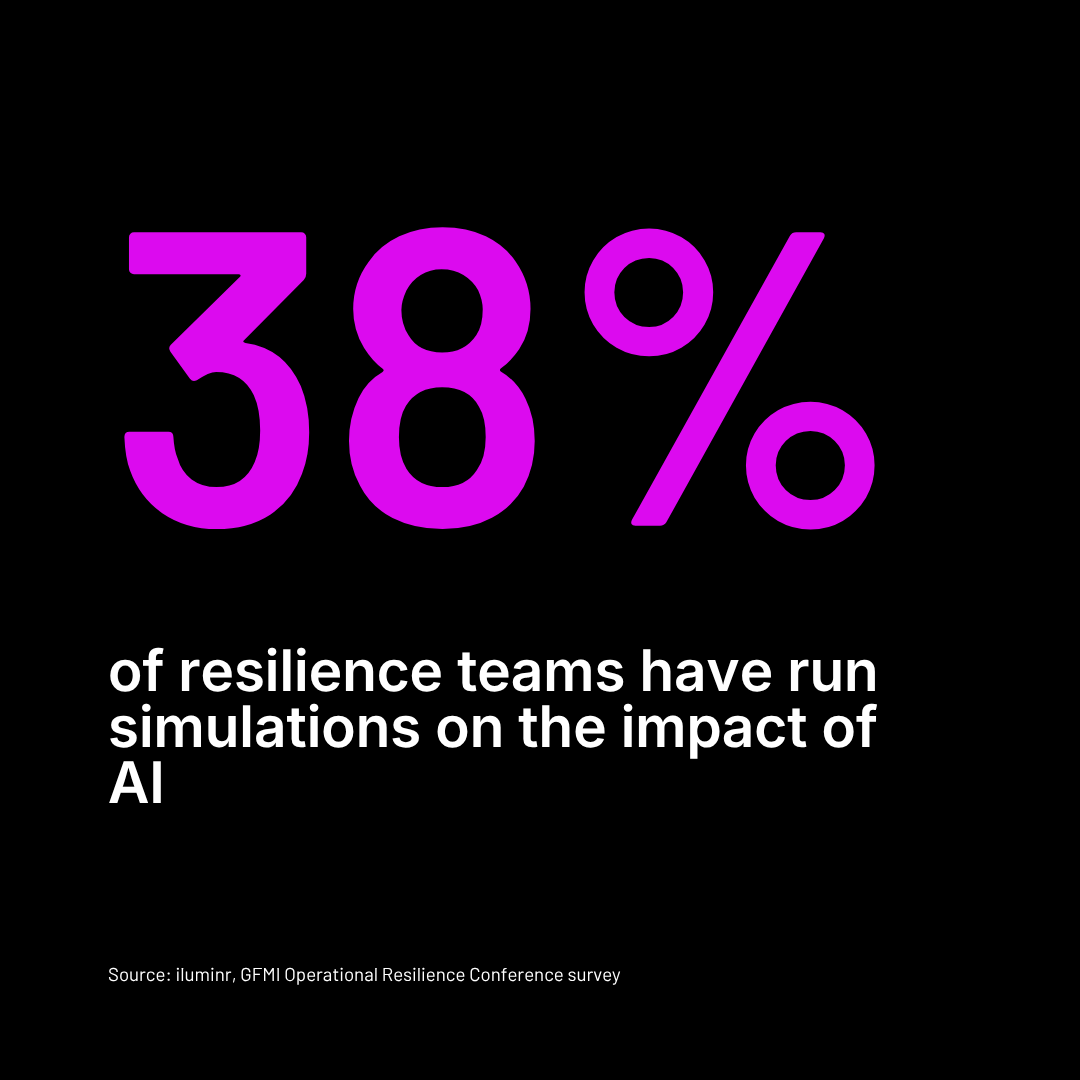
Consequently, this failure mode gets discovered live—in the one setting where discovery is the most expensive.
Test this: If you haven't simulated an AI failure, you haven't tested your true incident response capability. Leaving this specific failure mode unexamined creates a massive blind spot in operational resilience.
Building a Resilient AI Response
Agentic AI has earned its place in incident response. However, the teams that use it successfully treat the agent as a participant that can fail. They build guardrails around it, including:
- A named human authority to stop it instantly.
- A clear protocol for human-agent disagreement.
- Exercises that have already rehearsed the exact day the AI goes wrong.
iluminr builds agent failure into live microsimulations so resilience teams can face that day in a controlled setting first. The patterns above are drawn from what teams discover when the agent stops behaving - and the clock keeps running. Request our Agent Autonomous microsimulation or run our Model Switch microsimulation today.
.png)